You hear the words SEO, PPC, content marketing, and social media management. But what do these digital marketing modules actually mean? How do they fit together? Which ones do you need to learn first?
This article gives you a clear answer. I break down every major digital marketing modules in simple language. No confusing jargon. No fluff. Just practical knowledge you can use immediately.
By the end, you will understand each digital marketing modules well enough to decide where to start your learning journey or how to apply these channels to your business.
Chapter 1: What Are Digital Marketing Modules?
Before diving deep, let us define our terms. Digital marketing modules refers to the distinct building blocks that make up a complete online marketing strategy. Think of them like tools in a toolbox. Each tool serves a different purpose. A skilled marketer knows which tool to pick for which job.
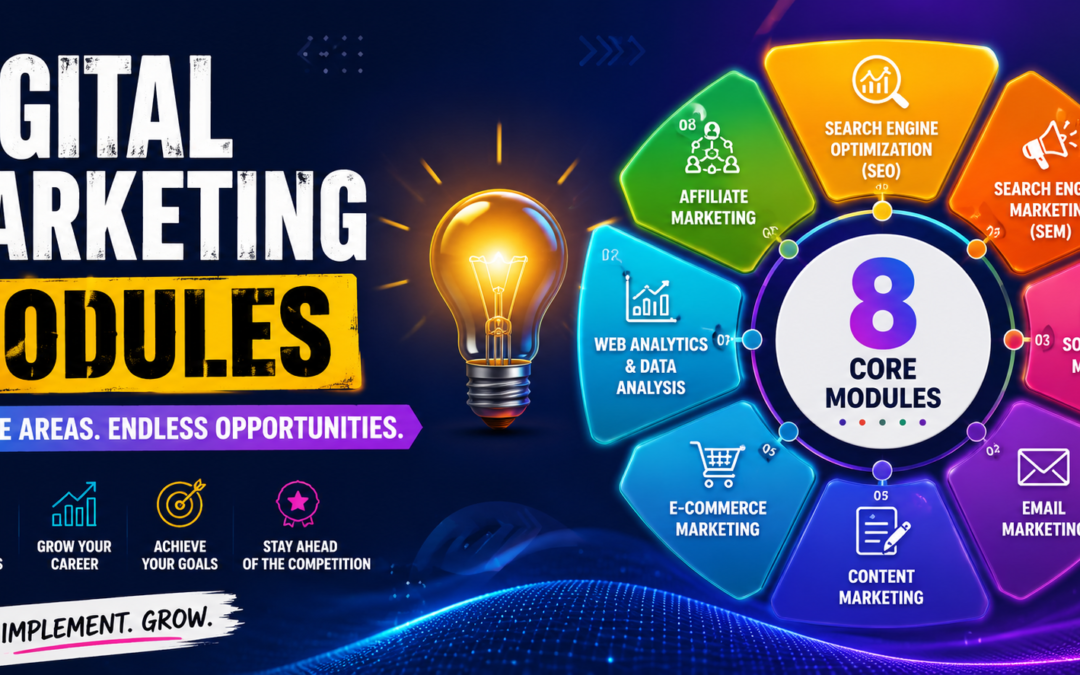
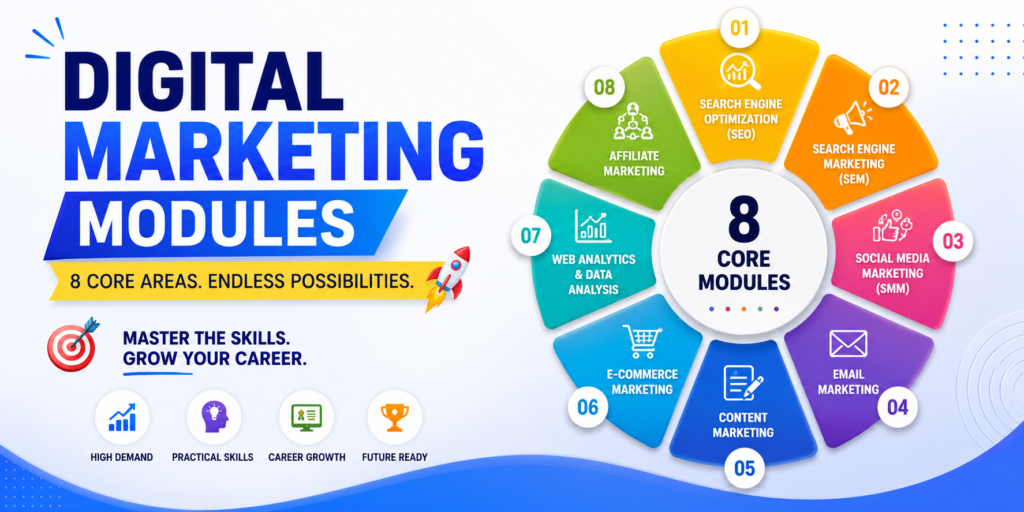
The eight main digital marketing modules in this guide are:
- Search Engine Optimization (SEO)
- Content Marketing
- Social Media Marketing
- Pay-Per-Click Advertising (PPC)
- Email Marketing
- Affiliate Marketing
- Analytics and Data
- Conversion Rate Optimization (CRO)
Each digital marketing modules below includes what it does, why it matters, and how to start using it today.
Chapter 2: Module 1 – Search Engine Optimization (SEO)
Search Engine Optimization is the practice of getting free traffic from Google, Bing, and other search engines. This digital marketing modules section covers the three main types of SEO.
On-page SEO means optimizing your website content. You research what people search for. Then you write articles, product pages, or guides that answer those questions. You also optimize titles, headings, and image names.
Off-page SEO means building your website’s reputation. Other websites linking to yours (backlinks) act like votes of confidence. More quality votes mean higher rankings.
Technical SEO means making your website fast, mobile-friendly, and easy for Google to read. This digital marketing modules area includes site speed, structured data, and proper URL structures.
Why SEO matters: SEO brings consistent, free traffic for months or years after you publish. No other digital marketing modules offers this long-term value. A single well-optimized article can generate thousands of visitors without ongoing ad spend.
How to start: Create a free Google Search Console account. Then write one 1,500-word article answering a question your customers ask. Optimize the title, headings, and meta description for that question.
Chapter 3: Module 2 – Content Marketing
Content marketing means creating valuable, relevant content to attract and retain a specific audience. This digital marketing modules area includes blog posts, videos, podcasts, infographics, ebooks, and case studies.
Why content marketing works: People do not buy from strangers. They first need to trust you. Content builds that trust. When you give away useful information for free, people see you as helpful, not pushy.
Types of content in this digital marketing modules:
- Blog posts – Answer questions step by step
- Videos – Show processes or explain concepts visually
- Infographics – Summarize data or steps in one image
- Case studies – Prove your results with real examples
- Lead magnets – Offer a checklist or template in exchange for an email
How to start: Pick one format that matches your strengths. If you like writing, start a blog. If you prefer speaking on camera, start a YouTube channel. Post once per week for 8 weeks. Track which topics get the most views.
Chapter 4: Module 3 – Social Media Marketing
Social media marketing uses platforms like Facebook, Instagram, LinkedIn, Twitter, and TikTok to connect with your audience. This digital marketing modules section focuses on organic (free) and paid (advertising) approaches.
Organic social media: You post content, engage with comments, and build a community over time. Organic reach on most platforms has declined, but it still works for building relationships.
Paid social media: You run ads targeting specific demographics, interests, or behaviors. Paid social delivers faster results than organic but requires a budget.
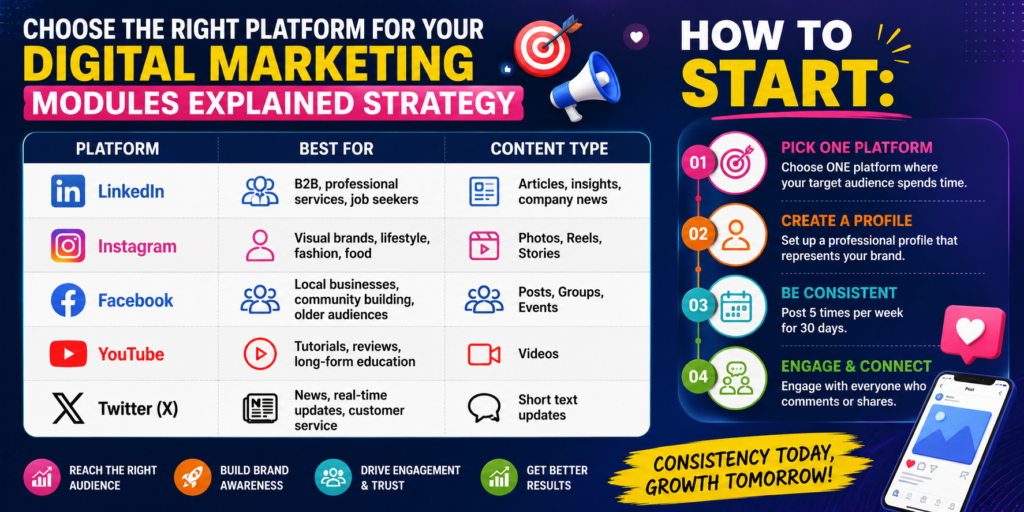
Choosing the right platform for your digital marketing modules strategy:
| Platform | Best For | Content Type |
|---|---|---|
| B2B, professional services, job seekers | Articles, insights, company news | |
| Visual brands, lifestyle, fashion, food | Photos, Reels, Stories | |
| Local businesses, community building, older audiences | Posts, Groups, Events | |
| YouTube | Tutorials, reviews, long-form education | Videos |
| Twitter (X) | News, real-time updates, customer service | Short text updates |
How to start: Pick ONE platform where your target audience spends time. Create a profile. Post 5 times per week for 30 days. Engage with everyone who comments or shares.
Chapter 5: Module 4 – Pay-Per-Click Advertising (PPC)
PPC means you pay each time someone clicks your ad. Google Ads is the largest PPC platform, but social media platforms also offer PPC options. This digital marketing modules area requires a budget, but it delivers the fastest traffic.
How Google Ads works: You bid on keywords related to your business. When someone searches that keyword, Google shows your ad. You pay only when someone clicks.
Key terms in this digital marketing modules section:
- Cost Per Click (CPC) – The amount you pay for one click
- Click-Through Rate (CTR) – Percentage of people who see your ad and click
- Quality Score – Google’s rating of your ad relevance (higher score = lower costs)
- Conversion Rate – Percentage of clicks that turn into sales or leads
Why PPC matters: SEO takes months. PPC works within hours. For a new product launch or seasonal promotion, no other digital marketing modules matches PPC’s speed.
How to start: Set a small budget (₹500-₹1,000). Create a Google Ads account. Choose 5-10 keywords closely related to your offer. Write two ad variations. Run the campaign for 7 days. See what happens.
Chapter 6: Module 5 – Email Marketing
Email marketing involves sending commercial messages to a list of subscribers who chose to hear from you. Many beginners ignore this digital marketing modules area, which is a huge mistake.
Why email marketing is powerful: You own your email list. Facebook or Google can change their rules tomorrow, but they cannot take your subscribers. Email also generates the highest return on investment of any channel – often ₹36 for every ₹1 spent.
Types of emails in this digital marketing modules:
- Welcome emails – Greet new subscribers and set expectations
- Newsletters – Share updates, tips, and offers periodically
- Promotional emails – Announce sales, discounts, or new products
- Abandoned cart emails – Remind people who left items in their online cart
- Re-engagement emails – Win back subscribers who stopped opening your emails
How to start: Sign up for a free Mailchimp or Brevo account. Create a simple lead magnet (PDF checklist or template). Add a signup form to your website. Send one email per week to your list.
Chapter 7: Module 6 – Affiliate Marketing
Affiliate marketing means paying other people (affiliates) a commission when they sell your product. This digital marketing modules area turns customers, bloggers, and influencers into your sales team.
How affiliate marketing works: You create an affiliate program. Affiliates sign up and receive a unique tracking link. They promote your product using that link. When someone buys through their link, you pay them a percentage.
Why consider affiliate marketing: You pay only for results. No sale means no commission. For businesses with digital products or high-margin physical goods, this digital marketing modules area offers massive scalability.
Who can be an affiliate: Bloggers, YouTubers, Instagram influencers, existing customers, industry experts, and even employees.
How to start: Use an affiliate platform like ShareASale, Impact, or a WordPress plugin (AffiliateWP). Set your commission rate (10-30% is common for digital products). Recruit 5-10 affiliates manually by reaching out to bloggers in your niche.
Chapter 8: Module 7 – Analytics and Data
Analytics means collecting, measuring, and analyzing data from your marketing efforts. Without this digital marketing modules area, you are guessing. With analytics, you know exactly what works and what wastes money.
Key tools for analytics:
- Google Analytics – Tracks website visitors, their behavior, and conversions. Free and essential.
- Google Search Console – Shows which keywords bring traffic from Google.
- Social media insights – Built-in analytics on Facebook, Instagram, LinkedIn, etc.
- Email platform reports – Open rates, click rates, and unsubscribe data.
Metrics that matter in this digital marketing modules section:
| Metric | What It Tells You |
|---|---|
| Traffic sources | Where visitors come from (Google, Facebook, direct) |
| Bounce rate | Percentage of people who leave without clicking anything |
| Conversion rate | Percentage of visitors who complete a desired action |
| Customer acquisition cost | How much you spend to get one paying customer |
| Lifetime value | How much a customer spends over their entire relationship with you |
How to start: Install Google Analytics on your website today. Check it every Monday morning. Look for trends, not daily fluctuations. Focus on conversion rate and traffic sources first.
Chapter 9: Module 8 – Conversion Rate Optimization (CRO)
Conversion rate optimization is the practice of increasing the percentage of visitors who take a desired action. This digital marketing modules area often gets ignored, yet it delivers huge wins.
What counts as a conversion: A purchase, a form submission, a phone call, an email signup, or any other valuable action.
Why CRO matters: You can double your sales without increasing traffic. If 100 visitors bring 2 sales (2% conversion rate), improving to 4% gives you 4 sales from the same 100 visitors. No extra ad spend required.
Common CRO tactics in this digital marketing modules section:
- A/B testing – Show two versions of a page to see which performs better
- Clear call-to-action buttons – Use action words like “Buy Now,” “Get Started,” or “Download Free Guide”
- Faster page load times – Every 1-second delay reduces conversions by 7%
- Social proof – Display testimonials, reviews, or trust badges
- Simplified forms – Ask for only essential information
How to start: Pick one page on your website – your homepage or a product page. Change one element (button color, headline, or form length). Run the new version for 2 weeks. Compare results with the original.
Chapter 10: How These Digital Marketing Modules Work Together
No single digital marketing modules works in isolation. The real power comes from combining them.
Example workflow for a small business:
- Use SEO to write a blog post answering a customer question (Module 1)
- Promote that blog post through social media (Module 3)
- Capture readers’ emails with a lead magnet (Module 5)
- Send a newsletter to those subscribers with a special offer (Module 5)
- Run PPC ads to people who visited but did not buy (Module 4)
- Track everything with analytics (Module 7)
- Improve your landing page with CRO (Module 8)
- Recruit affiliates to promote your product (Module 6)
This integrated approach multiplies your results. A skilled marketer does not pick one digital marketing modules. They learn to orchestrate all eight.
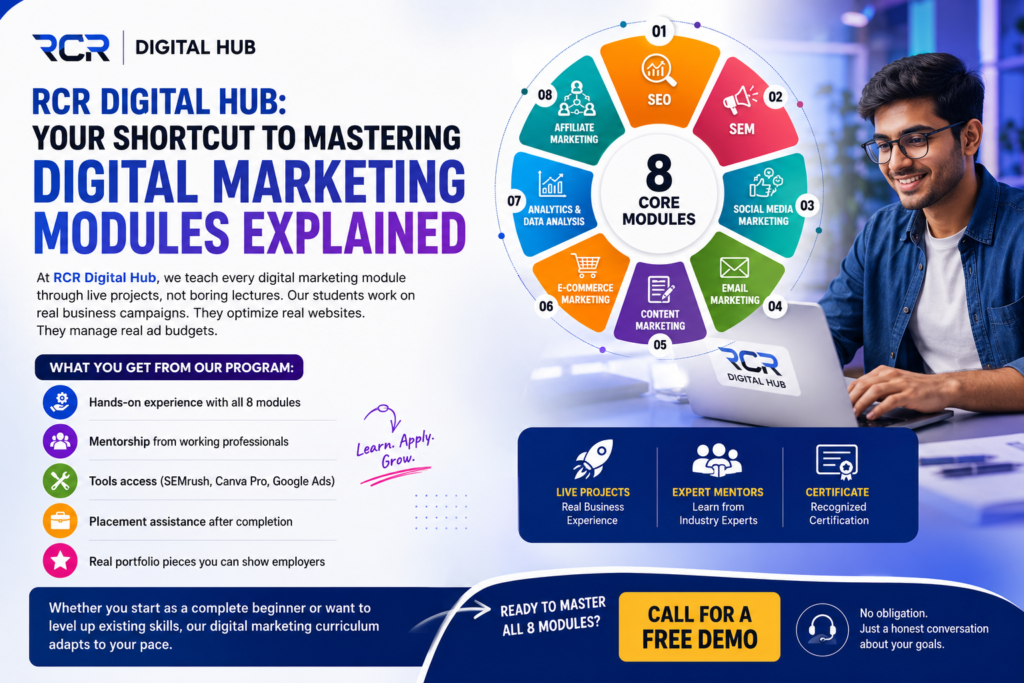
RCR Digital Hub: Your Shortcut to Mastering Digital Marketing Modules
At RCR Digital Hub, we teach every digital marketing modules through live projects, not boring lectures. Our students work on real business campaigns. They optimize real websites. They manage real ad budgets.
What you get from our program:
- Hands-on experience with all 8 modules
- Mentorship from working professionals
- Tools access (SEMrush, Canva Pro, Google Ads)
- Placement assistance after completion
- Real portfolio pieces you can show employers
Whether you start as a complete beginner or want to level up existing skills, our digital marketing modules curriculum adapts to your pace.
Ready to master all 8 modules? Click the “Call For a Free Demo” button on our website. No obligation. Just a honest conversation about your goals.
Frequently Asked Questions About Digital Marketing Modules
1. Which digital marketing modules should I learn first?
Start with SEO and content marketing. They cost nothing but time and build a foundation for all other modules.
2. How long does it take to learn all digital marketing modules?
You can understand the basics of each module in 2-3 months. Mastering all eight takes 6-12 months of consistent practice.
3. Do I need to master every digital marketing modules to get a job?
No. Most specialists focus on 2-3 modules. An SEO specialist rarely runs PPC campaigns. A social media manager may never touch email marketing.
4. Which digital marketing modules pays the highest salary?
Data analytics and PPC specialists typically earn the highest. However, any module pays well when you reach an advanced level.
5. Can I learn digital marketing modules for free?
Yes. Google Digital Garage, HubSpot Academy, and YouTube teach every module without cost. Paid courses offer structure and support but are not required.
6. How does RCR Digital Hub teach digital marketing modules differently?
We use live projects. You do not just watch videos. You work on real business campaigns and build a portfolio that gets you hired.
7. Which digital marketing modules works fastest for a new business?
PPC (Google Ads or social media ads) brings traffic within hours. SEO takes 3-6 months. Use PPC first while SEO builds.
8. Is digital marketing modules the same as a course curriculum?
Similar but broader. A course curriculum teaches specific topics. Our digital marketing modules guide gives you the complete landscape before you dive deep into any single area.
9. How often do digital marketing modules change?
Modules themselves stay stable, but tactics within them change frequently. SEO algorithms update monthly. Social media features evolve yearly. Continuous learning is required.
10. What is the first action to take after reading this digital marketing modules guide?
Pick one module. Any module. Take one small action within 24 hours. For SEO, write a title for your first article. For social media, create a profile. For email, sign up for Mailchimp. Action beats intention every time.
Conclusion
You now have every digital marketing modules in plain language. Eight modules. Eight clear descriptions. Eight ways to start.
SEO brings free traffic. Content builds trust. Social media grows community. PPC delivers speed. Email drives repeat sales. Affiliates scale reach. Analytics guides decisions. CRO maximizes results.
You do not need to master all eight today. Pick one. Take one small step. Then another. Consistency beats intensity.
Your next step: Comment below or email info@rcrgroups.in with the module you will start with. We will send you a free 7-day action plan for that specific module.