Every business owner faces the same question: where should I spend my marketing budget? Understanding digital marketing vs traditional marketing helps you answer that question with confidence.
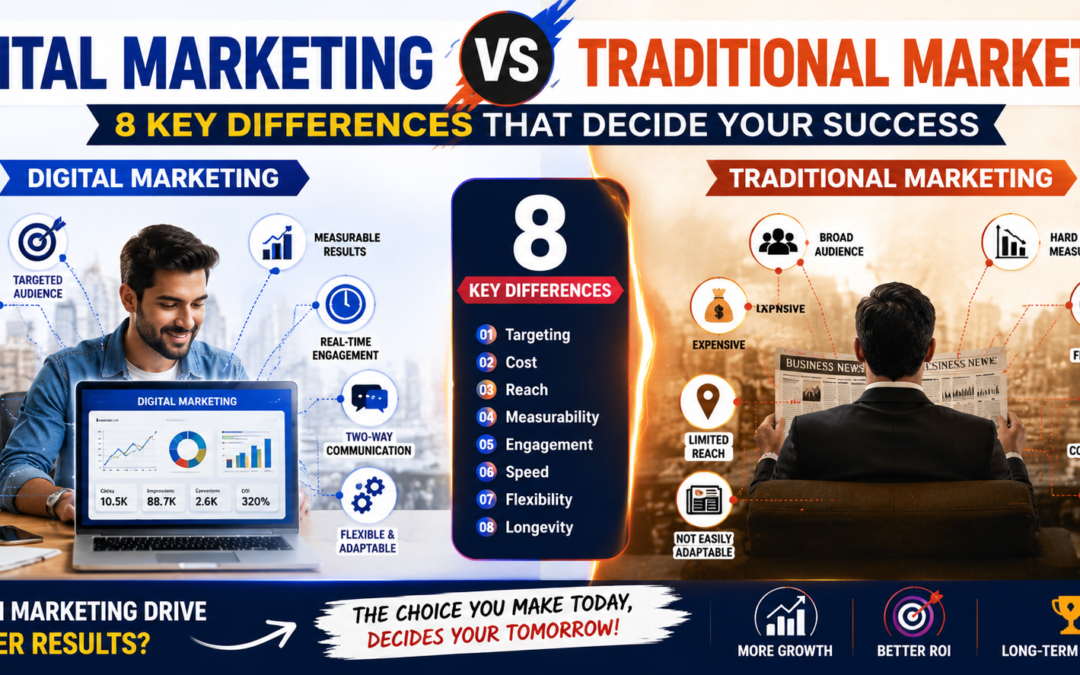
Digital marketing vs traditional marketing represents two completely different approaches. Digital marketing uses online channels like search engines, social media, email, and websites. Traditional marketing uses offline channels like television, radio, newspapers, magazines, and billboards.
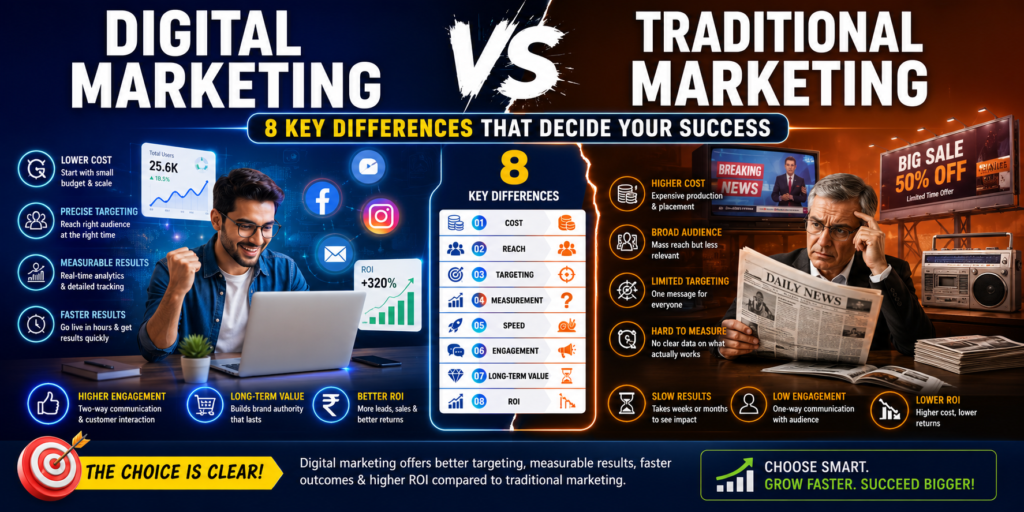
This guide breaks down digital marketing vs traditional marketing across eight key differences. You will learn about costs, reach, targeting, measurement, speed, engagement, long-term value, and ROI. Consequently, you will know exactly which approach fits your business goals and budget.
Chapter 1: Cost Differences in Digital Marketing vs Traditional Marketing
Cost often becomes the deciding factor when comparing digital marketing vs traditional marketing. Let us examine real numbers.
Traditional marketing costs:
A full-page newspaper ad in a major Indian city costs ₹50,000 to ₹2,00,000 for a single day. A 30-second television commercial during prime time costs ₹3,00,000 to ₹10,00,000 per slot. A billboard in a high-traffic Bangalore location costs ₹1,00,000 to ₹5,00,000 per month. These figures put traditional marketing out of reach for most small businesses and startups.
Digital marketing costs:
A Google Ads campaign starts at ₹500 per day. A Facebook advertising campaign begins at ₹250 per day. Search engine optimization costs nothing in ad spend — only your time or a freelancer’s fee. Email marketing costs ₹0 for lists under 500 subscribers using free tools like Mailchimp or Brevo.
Winner in digital marketing vs traditional marketing for cost: Digital marketing wins clearly. You can start with ₹5,000 and see measurable results within days. Traditional marketing requires large upfront budgets before you know if anything works.
Chapter 2: Reach and Scale – Digital Marketing vs Traditional Marketing
Reach means how many people see your message. However, reach without relevance simply wastes money.
Traditional marketing reach: A newspaper ad reaches the paper’s subscribers — usually a broad, unfiltered audience. A television commercial reaches anyone watching that channel at that specific time. A billboard reaches everyone who passes that physical location. The problem? Many of those people have zero interest in your product or service.
Digital marketing reach: A Facebook ad reaches only the people you select — by age, location, interests, online behavior, and even recent purchases. Google Ads shows your advertisement only to people actively searching for what you sell. SEO brings your content to people looking for solutions at that exact moment.
Winner in digital marketing vs traditional marketing for reach quality: Digital marketing wins decisively. It trades total eyeballs for relevant eyeballs. As a result, 1,000 relevant viewers generate more sales than 10,000 random viewers.
Chapter 3: Targeting Capabilities – Digital Marketing vs Traditional Marketing
Targeting means showing your message to the right person at the right time. This area shows one of the biggest gaps in digital marketing vs traditional marketing.
Traditional marketing targeting: You cannot show a newspaper ad only to men aged 25-35 who earn above ₹50,000. You cannot show a billboard only to pet owners who live within 2 kilometers. Traditional marketing blasts the same message to everyone regardless of interest or need.
Digital marketing targeting: You can show your advertisement specifically to women in Mumbai, aged 30-45, who have children, own a house, and recently searched for “kitchen renovation ideas.” You can retarget people who visited your website but did not complete a purchase. You can exclude existing customers from seeing new customer offers. Therefore, every rupee works harder.
Winner in digital marketing vs traditional marketing for targeting: Digital marketing by a massive margin. Traditional marketing simply cannot match this level of precision.
Chapter 4: Measurement and Analytics – Digital Marketing vs Traditional Marketing
You cannot improve what you do not measure. Consequently, digital marketing vs traditional marketing shows a huge gap in accountability.
Traditional marketing measurement: How many people saw your billboard? You can estimate traffic counts, but you cannot know for certain. How many called after seeing your newspaper advertisement? Unless you use a unique phone number for that specific ad, you cannot track it at all. Traditional marketing leaves you guessing about what works and what fails.
Digital marketing measurement: Google Analytics shows exactly how many people saw your advertisement, clicked it, visited your website, and completed a purchase. You see cost per click, cost per lead, and cost per sale in real time. You know which keyword, which advertisement, and which audience produced each result. Therefore, you can double down on what works and cut what fails immediately.
Winner in digital marketing vs traditional marketing for measurement: Digital marketing dominates completely. Real-time, precise data beats guesswork every single time.
Chapter 5: Speed of Results – Digital Marketing vs Traditional Marketing
Businesses often need results quickly. Digital marketing vs traditional marketing timing differs significantly here.
Traditional marketing speed: Creating a television commercial takes weeks or months. Placing a newspaper advertisement requires days or weeks of lead time. Once live, you wait for customers to see it, remember it, and then take action — which often takes days or weeks after the ad runs.
Digital marketing speed: Setting up a Google Ads campaign takes 2 hours. Your advertisements can go live today. People searching right now can click and buy within minutes of seeing your ad. SEO takes 3-6 months for rankings, but pay-per-click fills that gap immediately.
Winner in digital marketing vs traditional marketing for speed: Digital marketing wins clearly. PPC delivers traffic within hours. Traditional marketing cannot match this immediacy.
Chapter 6: Engagement and Interaction – Digital Marketing vs Traditional Marketing
Marketing works best as a two-way conversation, not a one-way broadcast. Therefore, digital marketing vs traditional marketing shows another major difference.
Traditional marketing engagement: A billboard cannot talk back. A newspaper advertisement cannot answer questions. A television commercial cannot ask for feedback. Traditional marketing speaks at people, not with them. Consequently, you never hear from your audience unless they make an extra effort to contact you.
Digital marketing engagement: A Facebook post gets comments, shares, and reactions within minutes. A blog post allows readers to ask questions directly below the content. An email campaign lets subscribers reply and start a conversation. Social media turns customers into brand advocates who promote you to their own networks.
Winner in digital marketing vs traditional marketing for engagement: Digital marketing wins decisively. Two-way interaction builds trust faster than any monologue ever could.
Chapter 7: Long-Term Value – Digital Marketing vs Traditional Marketing
Some marketing efforts stop working the moment you stop paying. Others keep delivering for months or even years. Digital marketing vs traditional marketing shows a stark contrast here.
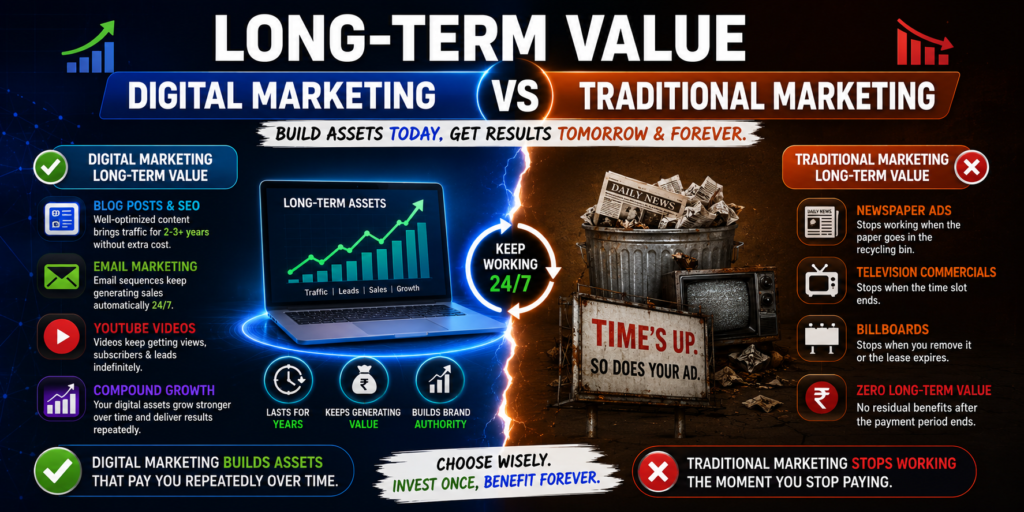
Traditional marketing long-term value: Your newspaper advertisement stops working when the paper goes into the recycling bin. Your television commercial stops when the time slot ends. Your billboard stops when you remove it or the lease expires. Traditional marketing offers zero long-term value after the payment period ends.
Digital marketing long-term value: A well-optimized blog post continues bringing traffic from Google for 2-3 years without any additional spend. An email sequence keeps generating sales automatically while you sleep. A YouTube video accumulates views, subscribers, and leads indefinitely without ongoing cost.
Winner in digital marketing vs traditional marketing for long-term value: Digital marketing wins completely. SEO and content marketing build assets that pay you repeatedly over time.
Chapter 8: Return on Investment – Digital Marketing vs Traditional Marketing
ROI ultimately determines which approach wins for your specific business. Let us look at real data comparing digital marketing vs traditional marketing returns.
Traditional marketing ROI: A typical newspaper advertisement generates 0.5% to 2% response rate. For every ₹1,000 spent, you might get ₹1,500 to ₹3,000 in sales if everything goes perfectly. However, because you cannot track most responses, many businesses never know their true traditional marketing ROI.
Digital marketing ROI: A well-managed Google Ads campaign generates 5% to 15% conversion rates. For every ₹1,000 spent, you commonly get ₹5,000 to ₹15,000 in sales. Email marketing averages ₹36 back for every ₹1 spent — a 3,500% ROI. SEO brings free traffic after the initial investment, producing even higher returns over time.
Winner in digital marketing vs traditional marketing for ROI: Digital marketing wins by a wide margin. Better targeting, better measurement, and lower costs naturally produce better returns.
Chapter 9: When Traditional Marketing Still Makes Sense
Despite digital’s many advantages, digital marketing vs traditional marketing does not mean traditional has no place. Certain situations still favor offline channels.
Local awareness campaigns: A billboard near your store works for foot traffic from people already in the area. Flyers distributed in a specific neighborhood reach residents who rarely search online for local services.
Older demographics: People over 65 still consume newspapers and television at high rates. If your target audience skews older, traditional marketing reaches them more effectively than social media.
High-ticket, trust-based sales: A full-page magazine advertisement in a respected publication builds prestige and credibility. Some luxury brands use print specifically to signal quality, permanence, and exclusivity.
Best approach: Use digital marketing vs traditional marketing as a blend, not a battle. Digital handles targeting, measurement, and speed. Traditional handles broad awareness and specific demographics that spend less time online.
Chapter 10: A Real-World Example from RCR Digital Hub
Let me give you a concrete example of digital marketing vs traditional marketing in action from our own client work.
The business: A local bakery in Whitefield, Bangalore. Monthly marketing budget: ₹30,000.
Traditional-only approach (before coming to RCR Digital Hub):
- ₹15,000 on flyers distributed in nearby apartment complexes
- ₹10,000 on a small newspaper advertisement in the local edition
- ₹5,000 on a 30-second radio spot on a community station
Result: 12 new customers per month. Cost per customer: ₹2,500. Zero data on which channel worked.
Digital-only approach (our recommendation):
- ₹15,000 on Facebook ads targeting people within 5 kilometers who like “bakery,” “cakes,” or “birthday parties”
- ₹10,000 on Google Ads for searches like “birthday cake near me” or “best bakery Whitefield”
- ₹5,000 on Instagram posts and stories (organic content plus small boosts for top performers)
Result: 86 new customers per month. Cost per customer: ₹349. Complete data on every click, call, and sale.
Understanding digital marketing vs traditional marketing saved this bakery ₹2,151 per customer. Consequently, they got 7 times more customers for the exact same budget.
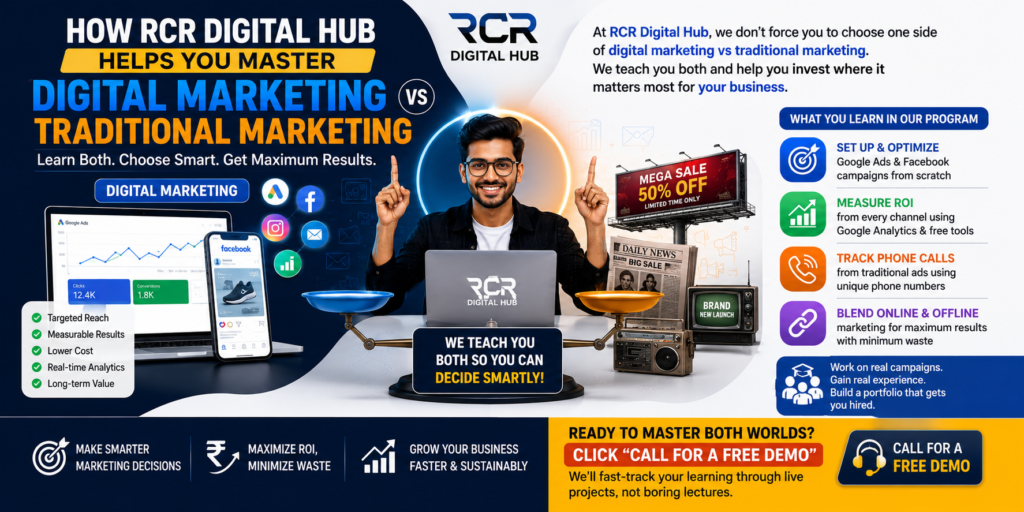
How RCR Digital Hub Helps You Master Digital Marketing vs Traditional Marketing
At RCR Digital Hub, we do not force you to choose one side of digital marketing vs traditional marketing. Instead, we teach you both. We then help you decide where to invest based on your specific business, audience, budget, and goals.
What you learn in our program:
- How to set up and optimize Google Ads and Facebook campaigns from scratch
- How to measure ROI from every channel using Google Analytics and other free tools
- How to track phone calls from traditional advertisements using unique phone numbers
- How to blend offline and online marketing for maximum results with minimum waste
Our students work on real campaigns for real businesses. They leave with a portfolio showing they can handle digital marketing vs traditional marketing decisions for any employer or client.
Ready to master both worlds? Click the “Call For a Free Demo” button on our website. We will show you exactly how we fast-track your learning through live projects, not boring lectures.
Frequently Asked Questions About Digital Marketing vs Traditional Marketing
1. Which is more effective — digital marketing vs traditional marketing?
Digital marketing is generally more effective for most businesses today because of better targeting, measurement, and lower costs. However, traditional marketing still works for specific audiences like older demographics or local foot traffic.
2. Can I use both digital marketing vs traditional marketing together?
Absolutely. Many successful brands blend both approaches. Use digital for targeting and measurement. Use traditional for broad awareness and local presence. The key is tracking everything so you know which channel drives each result.
3. Is traditional marketing dead because of digital marketing vs traditional marketing?
No. Traditional marketing is not dead, but its role has changed. It now works best for broad awareness campaigns, local businesses targeting foot traffic, and reaching demographics that spend less time online.
4. How do I measure traditional marketing results accurately?
Use unique phone numbers for each traditional advertisement. Use custom URLs (like yourwebsite.com/billboard) or QR codes. Therefore, you can track which billboard, newspaper ad, or flyer drove each call or visit.
5. Which gives faster results in digital marketing vs traditional marketing?
Digital marketing, specifically PPC (Google Ads and Facebook Ads), gives the fastest results. You can launch a campaign today and see traffic within hours. Traditional marketing takes days or weeks to produce any measurable results.
6. What do RCR Digital Hub students learn about marketing?
Our students learn both channels through live projects. They run real ad campaigns, track results using analytics tools, and learn exactly when to choose digital over traditional (and vice versa) based on real data.
7. Which has a better return on investment?
Digital marketing almost always delivers higher ROI because of precise targeting, real-time measurement, and lower entry costs. However, traditional marketing can still work for specific niches where digital reach is limited.
8. Do I need a big budget to start marketing?
For digital marketing, no. Start small with ₹5,000-10,000, test different approaches, and scale what works. For traditional marketing, yes — most traditional channels require significant upfront spend of ₹50,000 or more.
9. How does SEO fit into marketing?
SEO is a core part of digital marketing. It brings free, targeted traffic from Google over time — something traditional marketing cannot do at all. SEO also builds long-term assets that continue paying you for years.
10. What is the first step after reading this digital marketing vs traditional marketing guide?
Pick one digital channel from this guide (Google Ads, Facebook Ads, or SEO). Set a tiny budget of ₹1,000 or commit 5 hours to learning. Take action within 24 hours. Action beats intention every time.
Conclusion
You now understand digital marketing vs traditional marketing across eight key differences: cost, reach, targeting, measurement, speed, engagement, long-term value, and ROI. Digital marketing wins most categories. However, traditional marketing still has a pulse for specific situations.
The smart approach combines both. Use digital for precision, speed, and measurement. Use traditional for broad awareness and specific demographics. Track everything. Double down on what works. Cut what fails.
Your next step: Pick one digital channel mentioned in this digital marketing vs traditional marketing guide. Run a tiny test this week. Measure your results. Then contact RCR Digital Hub when you want to scale your success.