

Digital Marketing Beginner’s Guide: 10 Proven Steps to Start Today
Introduction
Do you feel lost when people talk about SEO, PPC, or social media algorithms? You are not alone. This Digital Marketing Beginner’s Guide removes the confusion. It gives you a clear path forward.
Marketing changed completely in the last decade. Billboards and newspaper ads still work, but online channels now reach more people for less money. A small shop in Whitefield can now compete with big brands. How? By following a solid Digital Marketing Beginner’s Guide.
This article walks you through ten practical steps. You will learn what works, what wastes time, and how to measure your success. No fluff. No fake promises. Just actionable advice.
Chapter 1: What Exactly Is Digital Marketing?
Before you spend any money, understand the basics. Digital marketing means promoting products or services using internet-connected devices. This includes smartphones, laptops, tablets, and smart TVs.
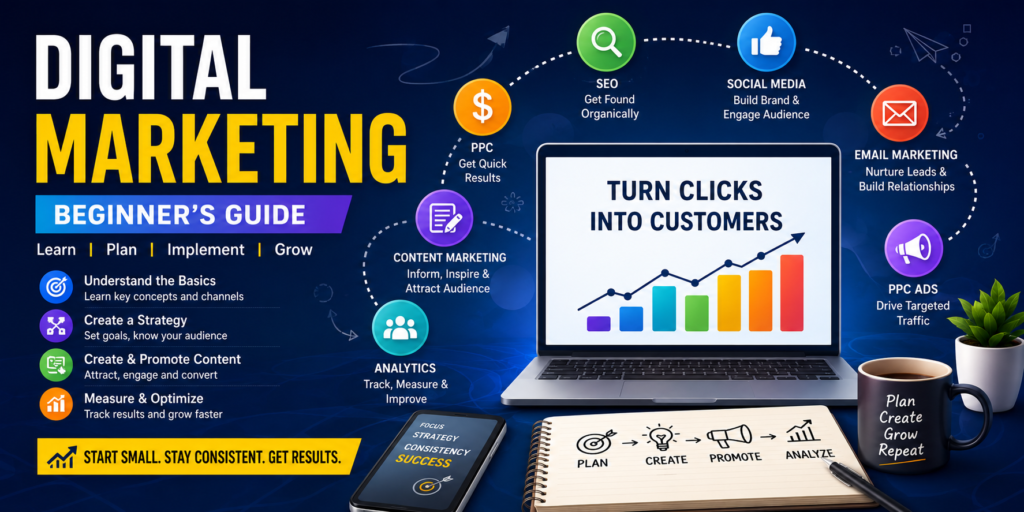
A good Digital Marketing Beginner’s Guide covers seven main channels:
- Search Engine Optimization (SEO) – Getting free traffic from Google
- Pay-Per-Click (PPC) – Paying for each visitor through ads
- Social Media Marketing – Building audiences on Facebook, Instagram, LinkedIn
- Content Marketing – Creating blogs, videos, and guides
- Email Marketing – Sending offers and updates to subscribers
- Affiliate Marketing – Getting others to sell for you
- Analytics – Tracking what works and what does not
Each channel serves a different purpose. SEO builds long-term growth. PPC brings quick sales. Social media creates community. This Digital Marketing Beginner’s Guide helps you choose the right mix for your business.
Chapter 2: Why Most Beginners Fail (And How You Will Succeed)
Every Digital Marketing Beginner’s Guide should warn you about common mistakes. Here are the top five failures:
Mistake 1: Trying every channel at once
Beginners spread themselves thin. They open a Facebook page, start a blog, run Google Ads, and send emails – all in the first week. Then they burn out. Fix: Pick ONE channel. Master it for 60 days. Then add another.
Mistake 2: Ignoring data
You cannot guess what works. A proper Digital Marketing Beginner’s Guide teaches you to check numbers weekly. Which posts get clicks? Where do people leave? Track everything.
Mistake 3: Selling too early
No one buys from a stranger. First, give value. Teach something useful. Answer questions. After you build trust, then sell. This Digital Marketing Beginner’s Guide recommends an 80/20 rule – 80% helpful content, 20% promotional.
Mistake 4: No clear goal
“Get more customers” is not a goal. A real goal sounds like this: “Get 50 new email subscribers in 30 days.” Be specific. Measure often.
Mistake 5: Giving up too soon
Results take time. SEO needs 3-6 months. Social media growth takes 2-3 months. A realistic Digital Marketing Beginner’s Guide prepares you for the long game.
Chapter 3: Step 1 – Define Your Audience (The Right Way)
Open a notebook or a Google Doc. Answer these questions:
- Who needs what you sell? (Age, job, income, location)
- What problems do they face daily?
- Where do they spend time online? (Facebook? LinkedIn? YouTube?)
- What questions do they type into Google?
This Digital Marketing Beginner’s Guide cannot overstate the importance of this step. When you know your audience, every decision becomes easier. You will know which blog topics to write, which social platform to use, and which words to put in your ads.
Example: If you sell accounting software for small restaurants, your audience is restaurant owners. They go to Facebook groups for restaurant owners. They search “how to reduce food waste” and “best accounting for small cafe.” Write content that answers those exact questions.
Chapter 4: Step 2 – Set One Measurable Goal
Goals without numbers are wishes. A serious Digital Marketing Beginner’s Guide demands specific, measurable targets.
Bad goal: “I want more website traffic”
Good goal: “I will increase blog traffic from 100 to 300 visitors per day within 60 days”
Bad goal: “I want more sales”
Good goal: “I will generate 20 new online orders per week by the end of month 2”
Write down your goal. Put it where you see it daily. Then break it into weekly actions.
Chapter 5: Step 3 – Choose Your Primary Channel
Based on your audience (Step 1) and your goal (Step 2), pick one channel. Here is how this Digital Marketing Beginner’s Guide recommends you decide:
| If you want… | Choose… |
|---|---|
| Free, long-term traffic | SEO + Blogging |
| Immediate visitors | PPC (Google Ads) |
| Community & engagement | Social Media |
| Direct sales to warm leads | Email Marketing |
Most beginners should start with SEO and content marketing. Why? Because it costs only time. Once you rank, traffic stays for months. PPC stops the moment you pause payment.
Chapter 6: Step 4 – Create a Simple Content Calendar
You need consistency. A content calendar prevents you from posting randomly. This Digital Marketing Beginner’s Guide suggests a 30-day plan:
Week 1: Publish one blog post (1,500+ words). Share it on LinkedIn and Facebook.
Week 2: Write one case study or success story. Turn it into a short video.
Week 3: Create a lead magnet (PDF checklist, template, or ebook). Collect emails.
Week 4: Send two emails to your new subscribers. One helpful tip. One offer.
Use free tools like Trello, Asana, or even a simple spreadsheet. Assign deadlines. Stick to them.
Chapter 7: Step 5 – Learn Basic Keyword Research
Keywords are the words people type into Google. A complete Digital Marketing Beginner’s Guide teaches you to find low-competition keywords.
Free method: Type a topic into Google. Look at “People also ask” and “Related searches.” Those are your keyword ideas.
Better method: Use Google Keyword Planner (free with a Google Ads account). Enter a broad term like “digital marketing.” Look for keywords with 100-1,000 monthly searches and low competition.
Example keywords for beginners:
- “digital marketing tips for small business”
- “learn digital marketing free”
- “how to start digital marketing with no money”
Write blog posts targeting these phrases. Do not go after “digital marketing strategy” – too competitive.
Chapter 8: Step 6 – Write Content That Answers Questions
Google ranks pages that solve problems. Every piece of content in this Digital Marketing Beginner’s Guide follows a simple formula:
- Identify a question your audience asks (e.g., “How do I start digital marketing?”)
- Write a clear headline with that question
- Answer immediately in the first 200 words
- Break down the answer into steps or subtopics
- Use examples and stories
- End with a specific next step
Do not write for search engines. Write for humans. Use short sentences. Short paragraphs. Speak directly to the reader – use “you” often.
Chapter 9: Step 7 – Set Up Free Tracking Tools
You cannot improve what you do not measure. This Digital Marketing Beginner’s Guide recommends three free tools:
Google Analytics – Shows how many people visit, where they come from, and what they do on your site. Install this on day one.
Google Search Console – Shows which keywords bring clicks from Google. Also alerts you to technical problems.
Ubersuggest (free version) – Shows your competitors’ keywords and backlinks. Limited but useful for beginners.
Install these tools within the first week. Check them every Monday morning. Look for trends, not daily ups and downs.
Chapter 10: Step 8 – Promote Your Content Aggressively
Publishing is only 20% of the work. Promotion is the other 80%. A smart Digital Marketing Beginner’s Guide includes these promotion tactics:
- Share on your personal LinkedIn and Facebook – Your network already trusts you
- Join relevant groups – Facebook groups, Reddit communities, LinkedIn groups. Answer questions and link to your article when relevant.
- Send to your email list – Even a list of 10 people. Ask them to share.
- Repurpose content – Turn one blog post into 5 tweets, 1 LinkedIn carousel, 1 YouTube short, and 2 Instagram slides.
- Comment on bigger blogs – Find popular blogs in your niche. Leave thoughtful comments with a link back to your article.
Do this for every piece of content you create. Consistency compounds.
Chapter 11: Step 9 – Build Your Email List from Day One
Most beginners ignore email. That is a huge mistake. This Digital Marketing Beginner’s Guide ranks email as the most valuable channel. Why? Because you own your email list. Facebook or Google can change their rules tomorrow. They cannot take your subscribers.
How to start:
- Sign up for a free Mailchimp or Brevo account
- Create a simple lead magnet – a PDF checklist, a template, or a 5-day email course
- Add a signup form to your website (sidebar, popup, or at the end of blog posts)
- Offer the lead magnet in exchange for an email address
Even 100 email subscribers can generate significant sales if you nurture them properly.
Chapter 12: Step 10 – Analyze, Adjust, and Repeat
After 30 days, review your numbers. This final step of the Digital Marketing Beginner’s Guide helps you avoid stagnation.
Questions to ask:
- Which blog post got the most views?
- Where did visitors come from? (Google? Facebook? Direct?)
- How many people signed up for your email list?
- What did you spend (time or money)? What did you get in return?
Then adjust:
- Double down on what worked – write more posts like your top performer
- Cut what failed – stop spending time on channels that bring zero traffic
- Test one new thing – try a different headline, a new social platform, or a longer article
Marketing is a loop, not a straight line. Do the analysis every month. Adjust every month. Repeat.
Real Examples from RCR Digital Hub
At RCR Digital Hub, we follow this Digital Marketing Beginner’s Guide daily with our students and clients. One student started with zero knowledge. She picked SEO as her channel. She wrote one blog post per week for three months. By month four, her posts brought 500 daily visitors from Google. She then added email marketing. Within six months, she launched her own freelance business.
Another client – a local bakery – used this Digital Marketing Beginner’s Guide to focus on Instagram. They posted daily behind-the-scenes content. They engaged with every comment. In 90 days, they grew from 200 to 5,000 followers. Online orders increased by 40%.
These results are normal when you follow a system. The system works. You just need to work the system.
Frequently Asked Questions (FAQs)
1. How long does it take to see results from this Digital Marketing Beginner’s Guide?
You will see initial traffic within 2-4 weeks. Significant results (100+ daily visitors or first sales) usually take 2-3 months of consistent work.
2. Do I need a big budget to follow this Digital Marketing Beginner’s Guide?
No. The first three steps require zero money. SEO, content marketing, and social media cost only your time. Add paid ads later when you have proven what works.
3. Which channel should a beginner start with first?
This Digital Marketing Beginner’s Guide recommends SEO and blogging for most businesses. It provides the best long-term return. Use social media only if your audience actively hangs out there.
4. How often should I publish new content?
Publish one long-form article (1,500+ words) per week. Share it across your social channels. Consistency beats volume.
5. Can I do this Digital Marketing Beginner’s Guide alone?
Yes. Many solopreneurs and small business owners follow these exact steps without a team. As you grow, consider hiring help for tasks like design or video editing.
6. What is the single biggest mistake beginners make?
Not tracking data. Without numbers, you cannot know what works. Install Google Analytics and Google Search Console on day one.
7. How do I know if my SEO is working?
Check Google Search Console weekly. Look for increasing clicks and impressions. Also check your rankings for target keywords (use free tools like Rank Math SEO or Ubersuggest).
8. Do I need to be on every social media platform?
No. That spreads you thin. Pick one platform where your audience spends time. Master that platform before adding another.
9. How does RCR Digital Hub help beginners?
We offer hands-on training, live projects, and mentorship. You learn this Digital Marketing Beginner’s Guide by doing real work for real businesses – not just theory.
10. What is the next step after finishing this Digital Marketing Beginner’s Guide?
Pick your first channel. Write down your goal. Create a 30-day calendar. Take action today. And if you need guidance, RCR Digital Hub provides practical training and done-for-you services.
Conclusion
You now hold a complete Digital Marketing Beginner’s Guide. You know the ten steps. You know the common mistakes. You have real examples and free tools.
The difference between those who succeed and those who fail is not talent or budget. It is action. One person reads this guide and closes the tab. Another person reads it and publishes their first blog post today.
Be the second person.
Open a new document. Write down your goal. Choose your channel. Create your first piece of content. Then come back to this Digital Marketing Beginner’s Guide next week for step two.
Your move: Share this guide with one friend who also wants to learn digital marketing. Then write your first 500 words today.